

By ELMINA FABON FALLAR
MAGSAYSAY’S JEEP
Easily the least luxurious, though no less important vehicle in the National Historical Commission’s collection is Ramon Magsaysay’s 1942 Willys Jeep. It was a standard issue military jeep, which he used as his official car when he was the Defense Secretary. The jeep had a line of owners, including General Douglas MacArthur who later gave it to Magsaysay as a gift. This is not one of the few Willys that were converted into public utility jeepneys after the departure of American troops.
QUIRINO’S IMPERIAL
President Elpidio Quirino used a 1953 Chrysler Crown Imperial limousine. The Imperial line was marketed above the standard New Yorker sedan. Those with the “Crown” in their name bore the top-of-the-line trim. The Imperial was propelled by a 5.4-liter hemi V8, and featured a number of then novel technologies. It was one of the first vehicles to offer power-assisted disc brakes, a 12-volts electrical system, an optional fully automatic transmission called PowerFlite, and optional air conditioning.
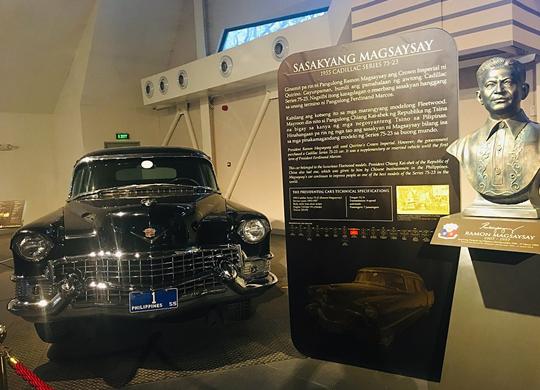
MAGSAYSAY’S CADILLAC
Ramon Magsaysay would eventually make the leap from the Willys jeep he used as defense secretary to presidential limousine. While he continued to use his predecessor’s Crown Imperial, another vehicle on reserve was the 1955 Cadillac Series 75-23. The vehicle had the top-of-the line “Fleetwood Limousine” trim, a precursor to the Fleetwood sedan that would succeed it. This came equipped with a 6.0 – liter V8, producing 305 horse power. The Series 75 was truly a regal offering, nicknamed the “high headroom” car, capable of seating eight passengers, and with a driver’s partition. The car was used as an auxiliary/ reserved vehicles until the first four-year term of President Ferdinand E. Marcos in 1965. The Series 75 was a popular choice for a state car with Chang Kai-Shek owning a similar model.
With the Magsaysay limo now restored, it still looks impressive and serves as one of the best examples of the Series 75-23.
MARCOS’S LINCOLN
President Ferdinand Marcos bucked the General Motors trend with his choice of a Lincoln Town Car Signature Series limousine. Though officially named the “Town Car” it is often still referred to as a Continental. Marcos’s Lincoln is an early 1980, model, as evidenced by the presence of the “Town Car” script above the headlight, which was discontinued in 1984. It was propelled by a 4.9 – liter V8, even though it was marketed as a 5.0 – liter. In spite of its classical setting, it featured new engine technologies like fuel injection and was offered with keyless entry as an option.
The vehicles were easily spotted by their vinyl coach roof, meant to re-create the look of a convertible. The vehicle’s regal appearance made it a favorite for stretch custom work, and appealed to the vanities of celebrities and men of power. Ford’s pinnacle model helped the brand regain the ground it lost to contemporaries Chrysler and Cadillac, which had cornered the market on luxury cars for decades.
IMELDA’S ROLL-ROYCE
The one vehicle that seemed to compete with the car President Marcos favored was owned by his own wife. While the president was chauffeured in a Lincoln, Imelda purred around in no less than a 1960, Roll-Royce Phantom V.
The Phantom V was based on the Silver Cloud II coupe, propelled by a 6-liter V8 engine and GM Hydromatic automobile gearbox. During this era, Rolls-Royce bodies were made by coachbuilders, former vendors absorbed by Rolls-Royce.
The Phantom V was another state car favorite, counting Queen Elizabeth and Elizabeth II; the old governors of Hongkong; Mohammad Reza Pahlavi, the Shah of Iran; King Olav V of Norway; and Yugoslavian President Josip Broz Tito. A total of 516 Phantom V’s were made.
CORY AND FIDEL’S W126
The Mercedes-Benz era began with People Power President Cory Aquino. She rode a W126 S-Class, the S-referring to Sonderklasse or “special class”. Aquino’s particular model was the 500 SEL, with the “L” indicating long wheelbase. As the nomenclature indicates, it was powered by a 5.0-liter V8.
After Aquino’s term, Fidel V. Ramos also used a similar model.
The W126 body S-Class had the longest production run of any series, spanning 12 years from 1979 to 1991. This body style also marked the first time Mercedes eschewed the traditional chrome bumpers for polyurethane deformable bumpers.
The NHCP is particularly proud of having Ramos’s Mercedes-Benz in its collection. The car had so many missing parts; the restoration project had to fabricate and replicate parts. It was almost like building another vehicle.
ERAP’S W140
Joseph “Erap” Estrada acquired a 1993 Mercedes-Benz S600 during his presidency. At this time, armoring technology had made significant technological advances. Mercedes-Benz had begun to introduce its factory-made line of specially armored vehicles called S-Guard.
Though it resembles any average S-Class, this particular vehicle is a special armored version. The S-Guard’s modifications allowed it to withstand small arms fire and explosive devices. It also had a self-sealing fuel tank and an alarm system. Ninety other governments worldwide use the special model to transport dignitaries and government officials. The S-Guard has its own production line in the S-Class factory in Sindelfingen, Germany, with specific S-Guard enhancements integrated at multiple stapes throughout the production process. The only evidence of the S-Class’s reinforcement is the thicker door cross sections and pillars. It also has a distinct lack of badging other than the Mercedes-Benz logos.
Armor aside, the regular W140 series marked a change in Mercedes-Benz’s naming system, with the class preceding the engine size (from 500 SEL to S 600). It’s massive 6.0 liter V12 originally produced 402 horsepower, detuned to 389 horsepower to meet tighter emission control regulations. The W140 also introduced innovations such as double-pane window glazing (non-armored cars), power assisted closing for doors and truck lid, anti-pinch electric windows, rear-parking markers which rose from the rear wings, and a climate system that could run with the engine off.
This particular vehicle has been restored to its original condition.
GMA’S STRETCH W140
There is a Napoleonic quality to former President Gloria Macapagal Arroyo’s vehicle. Though she was physically short, she used one of the country’s largest state vehicles. GMA rode a stretched 1993 S600 Pullman Guard. This model is 45 centimeters longer than the standard model and has a higher roof, and a taller rear window with a more vertical rake.
Besides the stretch, the car features heavy armoring all throughout the vehicle. Windows are made with double-inch thick glass panels. Sandwiched in between the panels is a special film capable of catching small and large arms rounds and dispersing the impact, without letting the bullet through. Thick steel plates line the body panels and door pillars. Tires can run even if they’re flat. And to handle all the extra weight, the already potent 6.0-liter V12, its suspension, and brakes feature modifications that can still drive and feel like a normal S-Class.
PINOY’S TOYOTA LAND CRUISER J200
Noynoy “Pinoy” Aquino uses a Toyota Land Cruiser (J200), the first Philippine president to opt for an SUV over the usual state sedan. His low-key choice reflects his “Tuwid Na Daan” (straight path) policy.
However, choosing a land cruiser might in fact, be a clever move, with the vehicle granting the driver and passengers a much more commanding view of the road and immediate area. Its 4×4 system may also come in handy on less than ideal roads.
In spite of its plain appearance, the presidential Land Cruiser is hardly run of the mill. From the factory, the vehicle was armored by a company in the Middle East that employed novel brands of Kevlar, carbon reinforced plastic, and plexiglass to reinforce the vehicle. This unusual combination of materials makes the vehicle in credibly light, and able to withstand small and large arms rounds. Its stock tires hide rigid run-flat inner wheels that allow the vehicle to continue rolling even after bullets puncture the tires. There’s also a second security door behind the rear tailgate to prevent inside access if the vehicle is stopped. It may also have a number of counter measures from a smokescreen to an alarm.


Add Comment