


AS a girl, I used to hear my teacher say that history knows no if. But let us pretend that this exercise is legitimate. Why is the Philippines the biggest Christian country in Asia? Would it be, if it were not for the heroic and tragic expedition led by Magellan and the |Spanish colonization that followed. Real history tells us that, for centuries, there were Muslim Sultanates in the Sulu archipelago and Mindanao. “Fictional history” can tell us that what happened to the biggest Muslim archipelago in the world – Indonesia, where the other Catholic country in Asia is Eastern Timor, a tiny spot on the map – could have happened to the Philippines. The seeds of the Gospel were also planted there but are now concentrated in just a small corner of one of Indonesia’s thousands of islands.
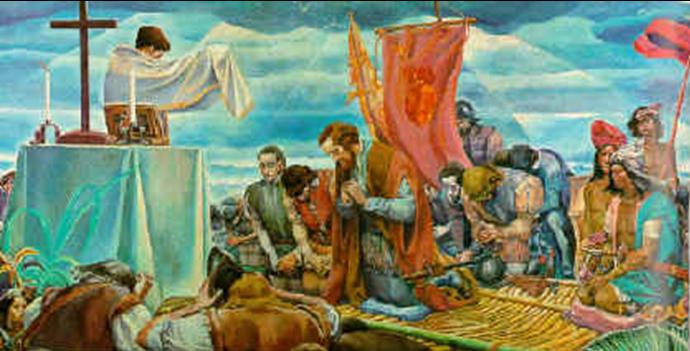
When I think about the heroic and tragic life of Magellan, I can’t avoid remembering that it was in the Philippines that the navigator found the peak of his faith. At the same time, to someone who had already defied death many times under much more difficult and harsher conditions, an almost absurd death. And when I think of this strange game of fate, I remember the words of an author when he describes, with the simplicity of ancient chronicles and in a beautiful style, the First Mass in the archipelago: “On Easter Sunday, the last day of March, Magellan sent a priest to land, in the early morning to officiate Mass in the island in the presence of the natives. Enrique (the slave he had baptized) accompanied the priest to explain that Magellan men were coming to land not to talk to the natives, but to assist in Mass. “The King offered immediately two dead pigs, perhaps thinking that they would make a sacrifice to the gods. At the hour of the Mass, fifty men came to land to assist in it, without any other weapon than the traditional sword. Before they disembarked, six cannon volleys were fired as a sign of their peaceful intents. Magellan, before Mass began, sprinkled both native kings with perfumed water.
At the moment of collection, the kings accompanied by Magellan and his men, came to the cross, kissed it but didn’t offer any alms. When the Host was raised, the kings knelt down together with the faithful and joined their hands in adoration while, in the anchoring place, fleet cannons were fired. At the end of the Mass, all received communion. A charismatic change seemed to have happened in Magellan’s character, it was visibly repeated during the six fallowing weeks before his death, not only in his behavior but also in what he was saying. The crossing of the Pacific from the triumphantly discovered strait to the Philippines of which he was the first (European) explorer, seemed to have been not only a period of resistance, but of intense spiritual solitude, of self-analysis and doubt, resulting in a greater consolidation of faith, and religious fervor now that finally he could see his adventure crowned by success Magellan led a conscious and well- succeeded campaign to Christianize Philippine Places where he passed through that we could ask reading the pages of Pigafetta (the expedition chronicler). – (Mrs. Elmina Fabon Fallar)



Add Comment